Cistercian Monastery Cârța
The monastery
Historical Context
The cistercian order was founded in 1098, in Burgundy by the abbot Robert de Molesmes, proclaiming the renouncing of St. Benedict’s rule.
The cistercians have introduced not only a new religious program but also an innovative architectural program that critiques the useless “pomposity” of benedictine constructions. The new architecture was more serious and simple, balanced, discreet and more functional, instead of having intricate decorations. The churches with a cross-shaped transept have replaced the benedictine semicircular shapes.
The first mention of the Cistercian Monastery in Cârța was in 1202, establishment constructed at the request of the cistercian monks of Igriș. The construction was built between 1202 and 1209 and was made of wood, in observance of the Roman architecture, typical for benedictine, not cistercian places of worship. The architectural style was in accordance with the local places of worship, because the typical cistercian architectural techniques did not yet enter Transylvania.

Starting with the Tatar invasion of 1241-1242 and up until the 16th century, the monastery was repeatedly destroyed. The church was rebuilt after the Tatar invasion by stone workers sent from abroad to help. This is the first entrance of gothic architecture in Transylvania.
In 1467, the king Matei Corvin decides to close the monastery because of the moral decadence of the monks, signing the property off, along with the land on which it stood, to the magistrate of Sibiu. The state of the monastery was already close to the present state, because of the Ottoman invasions.
Archaeological discoveries made in 1982 brought to surface some secular graves from the 13th and 14th century, in the north-eastern area of the transept. The monks are buried, according to cistercian traditions, under the chapter house or in the altar.
Construction and architecture
Even though the gothic style was already fully developed in Western Europe, the architecture of the Cistercian Monastery of Carta is more typical of early gothic, also named semi-gothic or “burgundy gothic”. Regardless, the monks accepted the construction of a polygonal choir (typical of fully developed gothic) instead of a rectangular choir (early gothic).
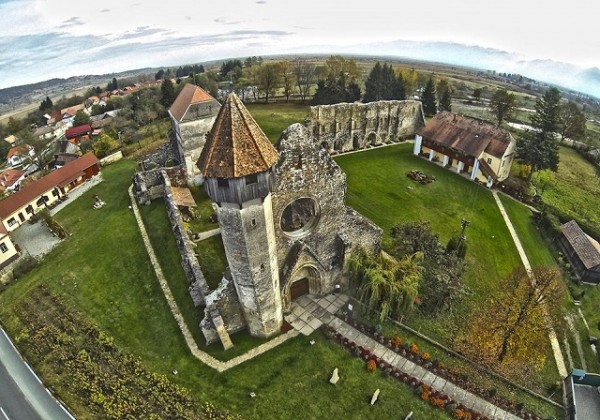
The monastery is organized in accordance with cistercian architecture: it has a rectangular space framed by the church on the northern side, buildings on the eastern and southern sides and a fortified wall on the west side. The church has a cross-shaped transept with two chapels on the eastern side, three connected naves (a central nave and two lateral naves) and a polygonal choir.

The religious establishment appears to be architecturally unified, showing that the works were carried out without much interruption. The only discrepancy in the unity of the architecture is the west facade of the church - the details indicate that it could be categorized as fully developed Gothic and might have been added to the construction later on, towards the end of the 13th century.
Why visit?
The establishment is the first testimony of the Transylvanian Gothic style and has a very important place in the history of medieval architecture.
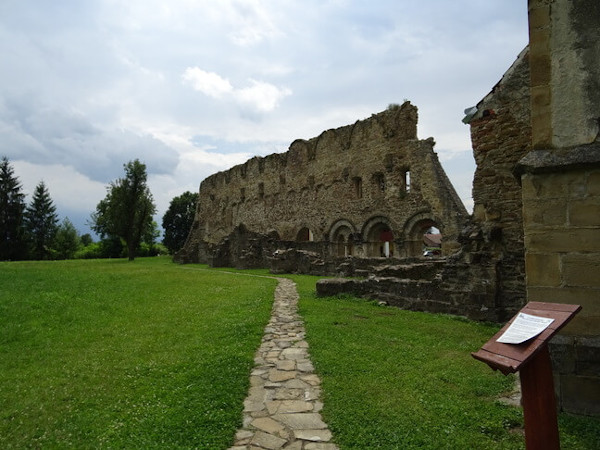
Today, the monastery is almost fully in ruins. Of the church, only the choir remained and was transformed to a Lutheran Parish church, the southern chapel is used as a sacristy and the western facade. The eastern buildings are in ruins, the southern buildings and the west wall are completely gone.
The Cistercian Monastery has a peaceful quiet garden where you can walk about and explore the ruins whose walls hold memories of the invasions and wars that Transylvania has suffered 700 years ago.
The horror movies aficionados will be drawn to the monastery because the movie “The Nun” was partly shot here.