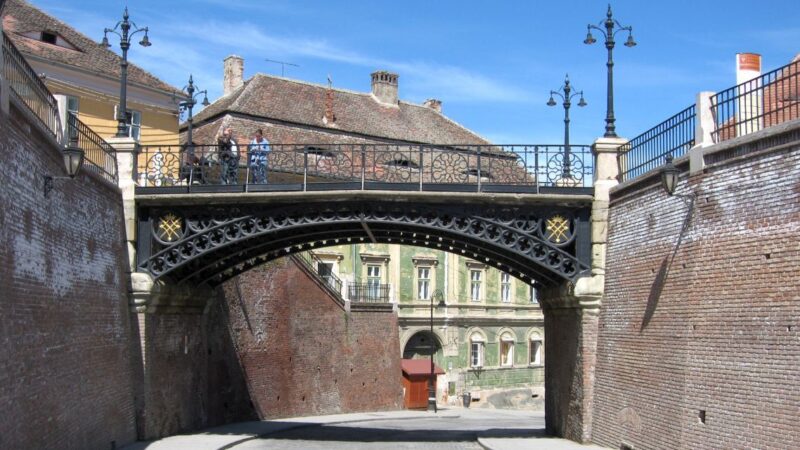

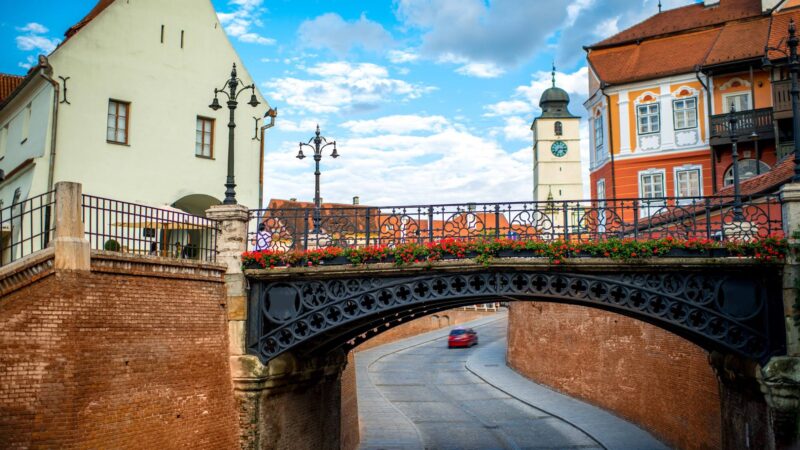
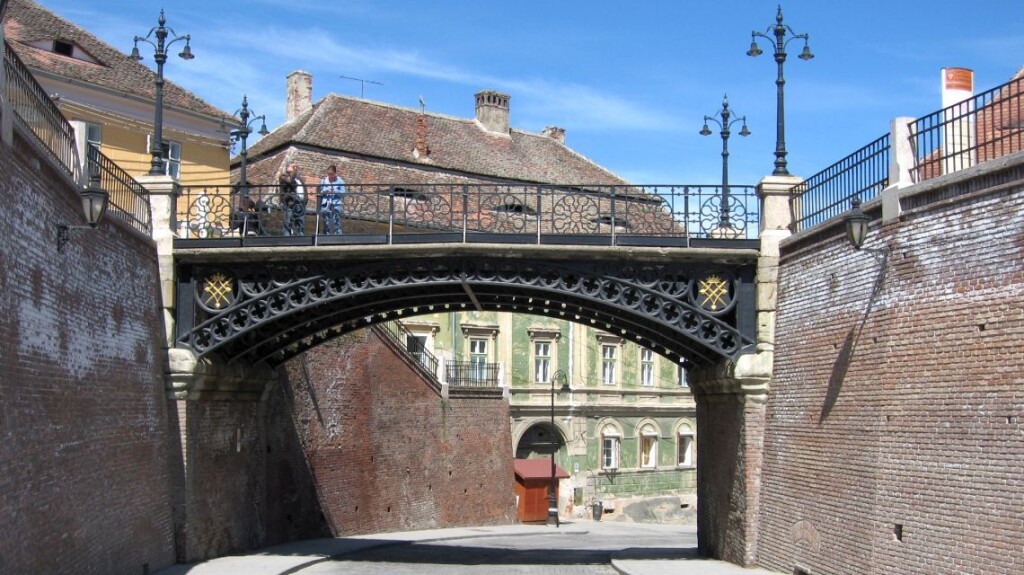
The Bridge of Lies (Lügenbrücke, in german) or Laying Bridge (Liegenbrücke) is the oldest cast iron bridge still in use in Romania. It was inaugurated in december 1860 and connects the Small Square and the Huet Square of Sibiu. The Bridge of Lies is a pedestrian bridge, crossing over the Ocna street - it connects the Upper Town and the Lower Town.
The bridge has two banisters with radial decorations inspired by gothic architecture. The two metallic arches have different decorations, thus on the southern side, the arch is adorned with circles decorated with the Sibiu emblem and on the northern side, the arch is adorned with circles that have 1859 written inside (the year of the construction) and “FRIEDRICHS HÜTTE” (the name of the foundry where it was built). At the ends of the bridges on either side, there are four cast iron lamp posts.
The Bridge of Lies is a place of many legends, explaining the name of this historical place one way or another. Thus, in the year 1935, Arnold Pancratz mentions in “Die Gassennamen Hermannstadts” that this place is a meeting place on fair days, where locals would share the news of the world - mostly gossip invented by the peasants at the market.
Furthermore, the Bridge of Lies was a place lovers enjoyed walking on while promising each other eternal love and forgetting their promises rather easily. It is also said that young girls would swear to be maidens, but those discovered to be lying would be thrown over the banister.
Another legend speaks about the large number of cadets studying at the Military Academy of Sibiu, cadets admired by the ladies of the high society and not just. The cadets would meet the young ladies and profess their love to them, without keeping their promises.
The Bridge of Lies was included on the historical monuments list and was restored in 2006 with special attention to details when cleaning the cast iron. The works were executed for free and included in the cultural sponsorship of Sibiu - declared European Cultural Capital of 2007.