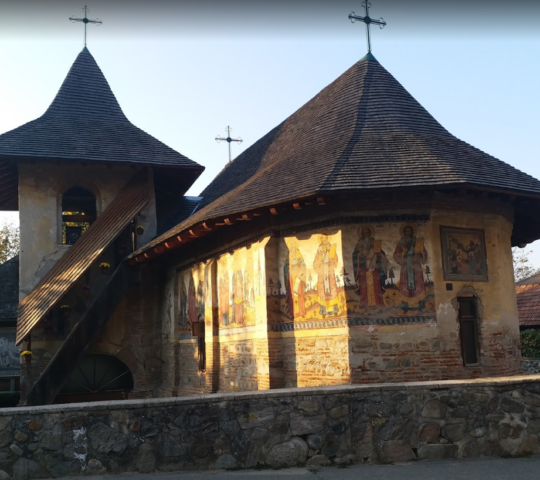
Curtea de Argeș Monastery
The Curtea de Arges Monastery was founded at the request of Neagoe Basarab by Manole with his craftsmen and builders. Construction began in 1512 during the time of Neagoe Basarab and ended during the time of his son-in-law, Radu of Afumați in 1526.
Being one of the most imposing and elegant constructions of religious character in Romania, it is adorned with special paintings carefully and soulfully crafted. Dobromir is the one who took care of the painting of the monastery, realizing special works that show Neagoe with his family.
Inside the monastery, in the old iconostasis, we can find some icons from the time of Serban Cantacuzino of the seventeenth century, the gospel written in gold letters by Queen Elizabeth and the paintings of King Carol I and Queen Elizabeth.

Curtea de Argeș Monastery, before the late 19th century restoration
In the narthex there is the crypt of Neagoe Basarab, Radu de Afumați and the kings of Romania: Carol I, Ferdinand I, Carol II, along with their spouses: Elizabeth and Maria.
Location and Surroundings
At the end of a linden boulevard in Curtea de Argeș, the monastery of the same name is the most important place of pilgrimage in Argeș county, with the dedication of “The Assumption of the Virgin Mary”.
The architectural monument is located in a enchanting, green and peaceful setting. This awakens every tourist’s desire to stay in this soothing and magical place. The courtyard of the Monastery is spacious and elegantly decorated with fragrant flowers.

The Curtea de Argeș Monastery is located in a peaceful park
History
Once he became ruler of the Romanian Country, Neagoe Basarab decides to rebuild over the ruins of the old church a new monastery to prove his patriotism and faith.
The Curtea de Argeș Monastery is a symbol of the faith and humility of the Romanian people. Sanctified in 1517 on August 15, it bears the dedication of the Assumption of the Virgin.
Begun in 1514 from Neagoe Basarab’s strong desire to create an incomparably beautiful monument, the works were completed three years later. Thus, on January 7, 1517, the founder spoke of “the monastery of my lordship in Argeș”.
According to historical legends or news, the Curtea de Argeș monastery was not painted due to lack of money. It was only after Neagoe Basarab’s passing that it was completely painted.
The historical sources support the hypothesis that Neagoe Basarab built his monastery on the foundations of an older place that was the seat of the first Metropolitan Church of the Romanian Country.
Since 1914, the Curtea de Argeș Monastery serves as a necropolis for the royal family, being the resting place of the kings and queens who ruled Romania in the following years. These include: Carol I, Elizabeth, Ferdinand, Maria and Carol II.
Construction and Architecture
The Curtea de Argeș monastery is a place of worship admired for impeccable architectural work. It measures 18 meters long, 10 meters wide and 25 meters high.
The place of worship consists of the altar, the nave and the nathrex. The monastery is organized in two distinctive parts both on the outside and on the inside, the first in trilobate form with 3 equal semicircular rooms comprising the altar and the nave and the second in rectangular form composed of 4 parts that form the nathrex.
Curtea de Argeș Monastery has undergone several restoration works. The last was carried out by the French architect André Lecomte du Noüy who made changes which reduced its historical value.
The present appearance is made up of an enlarged nathrex adjacent to the original construction, with 12 interior pillars that support the tower and the two side turrets. The nathrex also had the function of necropolis.
In front of the entrance there is a holy water font, decorated with laced arches and supported by four marble columns. Like the rest of the monastery, it is a work of art.

The holy water font of the Curtea de Argeș Monastery is adorned with lace details
Church art
The painting of the Curtea de Argeș Monastery was made at the request of Neagoe Basarab by Dobromir, a very famous and talented painter, assisted by his disciples.
Known for the frescoes in the Curtea de Argeș monastery, Dobromir of Târgoviște is a very talented church painter who remained modest throughout his life. The painting of the church ended in 1526 but the iconographic schedule of the painter Dobromir could not be approximated.
In 1860, the painter Gheorghe Tattarescu made some sketches to Curtea de Argeș which were then collected in the National Album. In 1881, the French architect who coordinated the restoration of the Curtea de Argeș monastery, André Lecomte du Noüy decided to withdraw the original fresco, work completed a year later.
Less than a tenth of the surface of the original fresco survived, more exactly 35 fragments. They were eventually extracted to keep them in optimum conditions. The remaining fragments are: The votive portrait of Neagoe Basarab and his family, that of Mircea cel Bătrân, the portrait of Miss Ruxandra.
The technique, the background and the style of the paintings made the works famous; they were made using gold or silver and adorned with precious stones.

The painting of the monastery was made by the painter Dobromir around the year 1520 and then restored between 1875-1886
Legends
Master Manole and Ana
Near the Curtea de Argeș monastery is the fountain of Master Manole, the famous builder of the Neagoe Basarab’s monastery, the hero of popular ballads.
The ballad “Monastery of Argeș” says that the master Manole built his own wife, Ana in this construction. The inexplicable way in which everything that was built during the day was torn down overnight made Manole put her soul into this fortification.
Manole dreamed that if he sacrificed his wife, the construction would withstand. Ana, when she came to see the master, was seized by him and built between the walls of the monastery, on the south side of the building. Starting with that night, the construction stopped breaking down during the night, the sacrifice lifting the curse that was placed on the site.
The same legend gives us an explanation for the fountain of Manole: when the ruler saw the impressive construction he brought ten craftsmen and asked them if they could build a more beautiful and larger monastery than this.
The masters confirmed that they could raise something similar and the sovereign, in order to eliminate any possibility of someone ever building another larger monastery, ordered the demolition of the scaffolding on which the masters were mounted and therefore “ten grand masters, day laborers and masons” remained on the roof.
They made wings from the shingles and threw themselves from the roof in the hope of getting to the ground unharmed, but all died. In the place where Manole collapsed, a spring appeared - Manole’s fountain.

The masters made wings out of shingles to save themselves
The relics of Saint Filofteia
The relics of Saint Filofteia are placed in the Curtea de Argeș Monastery as of 1393 and are celebrated by the Romanians on December 7th. The tomb of Saint Filofteia was restored in 2004 by the State Mint.
They covered the wood of the coffin with red velvet, sanded the silver pieces, re-covered the coffin lid and changed the support legs, made of aluminum. The craftsmen who restored the casket were surprised when they discovered on the bag covering the relics a curse for those who try to steal the relics. The curse is as follows:
Cosma, Milostiv Bogin - with the mercy of God Archbishop of the Metropolitan Church of Ungrovlahia, because we are notified as from the Holy Relics of the Holy Roman Catholic Philothe, who is in the Royal Church in Argeșu, we would have scattered in small portions, to your covetousness, Your Holiness I request that Parthenie, Igumen Argeșului, seal them in a small bag of new embankment, leaving only the right hand out for the people to kiss. And so sealed to put them in the coffin. And to know every one to be careful not to disturb any of the holy relics, that I have put a curse on whomever touches. In this and face to face! And be blessed! 1791, May 10
As for Filofteia’s life, it is only known that she had the task of bringing food to her father, who worked in the field. On the way, however, she met many needy people and graciously shared food with them. Her father found out and stroke Filofteia in a fit of rage; because of this wound she entrusted her soul to God, at the age of only 12 years.

The coffin containing the relics of St. Filofteia
Photos
Useful information
Address:
The Curtea de Argeș Monastery is 150 km from Bucharest and 36 km North - West from Pitesti. The easiest way to get to Curtea de Argeș Monastery is the Bucharest - Pitești highway, then follow the road to Curtea de Argeș. The exact address is no. 1 Basarabilor Boulevard, Curtea de Argeș.
Schedule and fees
The schedule of the Curtea de Argeș Monastery varies, the summer being between the hours of 8:00 - 20:00.
In winter you can visit the Monastery between 9am and 5pm.
The entry fee is 3 lei.
The fee for taking photographs on the premises is 30 lei.