Bridge of Lies

Summary
The Bridge of Lies (Lügenbrücke, in German) or the Lying Bridge (Liegenbrücke) is the oldest cast iron bridge still in operation in Romania. It was inaugurated in December 1860 and connects the Little Square and the Huet Square in Sibiu. The Bridge of Lies, actually a pedestrian walkway, passes over Ocna Street, which connects the Upper Town with the Lower Town.
The bridge has two balustrades with radial decorations, of Gothic inspiration. The two arched metal crossbars are decorated differently, thus on the southern side there are circles decorated with the coat of arms of the city of Sibiu, and on the northern side the circles bear the inscription 1859 (year of construction) and “FRIEDRICHS HÜTTE” (after the name of the foundry where it was built). At the ends of the bridge, on either side, there are four cast-iron lanterns.
Several legends are connected to the Bridge of Lies, which in one way or another explain the name of this place full of history. Thus, in 1935, Arnold Pancratz mentions in his work, in “Die Gassennamen Hermannstadts” that this place is a meeting place on market days, when the inhabitants shared their news of the city, usually gossip invented by the peasants who arrived at the market.
Also, the Bridge of Lies was a favorite promenade for lovers, who made vows of eternal love, often forgetting the promises made. Also here it is said that the young girls swore they were virgins, but after the wedding night some of them proved to be liars, which is why they were brought to this bridge and thrown over the railing.
Another legend is related to the existence of a large number of cadets who studied at the Military Academy in the Sibiu citadel, who were admired by high society ladies and not only. They would meet young ladies, to whom they would make vows of love, without, however, keeping their word.
The Bridge of Lies was included in the list of historical monuments, being restored in 2006 with special care to preserve the patina of the cast iron, being cleaned using special methods. This work was performed free of charge, as part of the cultural sponsorships dedicated to Sibiu, which was declared the European Capital of Culture in 2007.
Between truth and lies
The Bridge of Lies in Sibiu has its name associated with several legends, but it is certain that the place was known as one of bad reputation in the old medieval citadel. It is said that fairs were held here, where merchants tried to trick their customers, who demanded an account from them, to the laughter of the crowd. Moreover, if these conflicts were not resolved amicably, the merchants were thrown off the bridge. Also, here the traders from the surrounding villages would meet, spreading gossip and false rumours.
Another story says that the bridge has ears and that anyone who steps on it and tells a lie will be thrown off the bridge. A lesser-known legend related to this bridge reveals that merchants who wanted to sell their goods in the citadel were forced to pay a tax. In the case of the chicken trade, the tax was different for white and black hens, it being believed that white hens lay more eggs. To avoid paying a higher tax, merchants painted the white chickens black.
The place is also known as a promenade for the young ladies who used to meet the handsome cadets of the Military Academy in Sibiu, who promised them eternal love, but did not keep their word. Another legend says that girls who proved not to be virgins on their wedding night were brought here and thrown off the bridge as punishment.
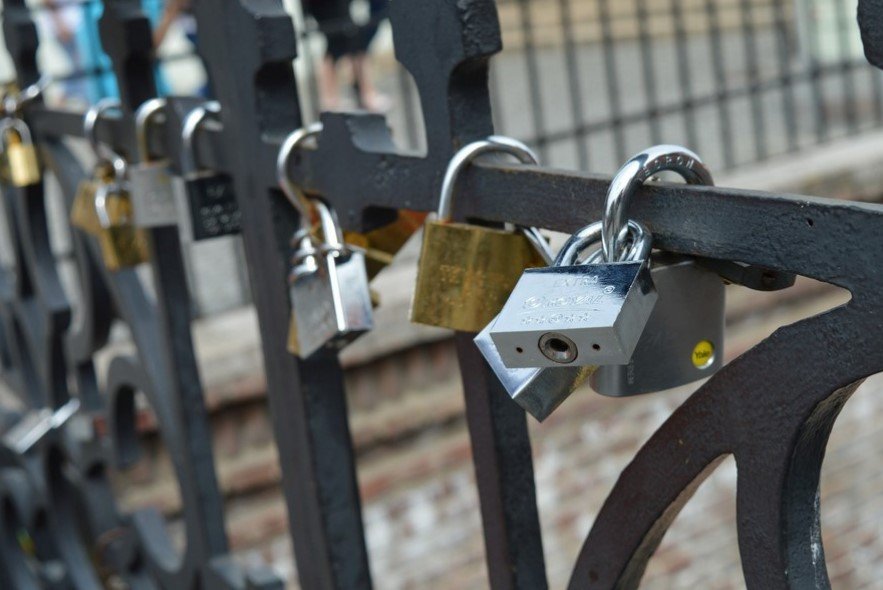
Probably the most popular legend remained the one related to the false vows of love; today, couples in love who arrive here promise each other eternal love, vows symbolically expressed through padlocks attached to the bridge’s iron grating. Because of their weight, which could damage the structure of the bridge over time, the Sibiu Household Service periodically removes them to make room for others.
It seems that the name of the bridge comes, however, from a phonetic confusion, between two homophonic expressions in the German language – Liegenbrücke – “Lying Bridge”, probably due to the fact that it has no supporting pillars and Lügen or Lügnerbrücke, meaning “Liar’s Bridge” ” or “of lies”.
An unhealthy area becomes a tourist attraction and promenade
Access to the medieval fortress of Sibiu was, until the middle of the 19th century, through a tunnel that passed under today’s Bridge of Lies, as it appears from the “Chronik der Stadt Hermannstadt”, written in 1771 by Emil Sigerus: ” the passage under the Bridge of Lies is illuminated at night by three lanterns and guarded by three sentinels”. This area had been called the “Bench of Lies”, a name given by Damasus Dürr (priest, German writer) in the 16th century.
In the period between the 15th and 19th centuries, the connection between Ocnei Street and the central squares of the citadel, i.e. between the Upper Town – where the villas of the largest citadel were located – and the Lower Town – the place where they lived and craftsmen and common people worked, it was done through a dark and long tunnel. A row of houses was built above the tunnel, dividing the Small Square in half.
The entrance area to the citadel had become unsanitary, being suffocated with garbage and becoming a veritable hotbed of infection. Because of this, the city magistrate decides to demolish this row of houses, arranged above the tunnel, until close to the Council Tower. As a result, the houses were demolished in 1851, and the tunnel was redeveloped into a passageway. Initially, a simple, wooden pedestrian walkway was built across Ocnei Street, connecting the Small Square (Kleiner Ring in German) to the Huet Square (Huetplatz in German), connecting the Upper Town and the Lower Town.
The cast-iron bridge was formed in 1859 at Friedrich Hütte’s foundry, in Covasna county, and installed in Sibiu a year later, its inauguration taking place on December 17, 1860. The Bridge of Lies is the oldest cast-iron bridge still in service from the current territory of Romania and the second of its kind in Europe.
Although it originally served as a passage for carts and an area for holding fairs, the Bridge of Lies, as well as the street below (Ocnei Street), were set up as promenade areas, lit with lanterns.

Architecture
Description
The Bridge of Lies in Sibiu is made of cast iron and is guarded by two metal railings; they are composed of eight panels with circles with radial decoration, in the Gothic style.
The bridge is 10.40 meters long and consists of a footbridge, clad in four arched metal crossbeams and decorated with rosettes and each with a girdle of vegetal or geometric ornaments, framed in circles, of Neo-Gothic influences. The arched crossbeam on the south side it has the circles at the ends decorated with the coat of arms of Sibiu, and on the one on the north side you can read the inscriptions “1859”, respectively “FRIEDRICHS HÜTTE”.
At the ends of the bridge we find four massive stone plinths, which serve as supports for the street lighting fixtures. The lanterns changed their shape over time, originally they had glass panes, which were later removed. A final renovation job consists of changing the cast iron bracket so that it supports two lanterns on each plinth.


Bridge of LiesInformații utile
Piața Mică, Sibiu, Romania
Bridge of LiesPrognoză meteo
Bridge of LiesAlte obiective de interes
 pentru a vedea categoriile de obiective